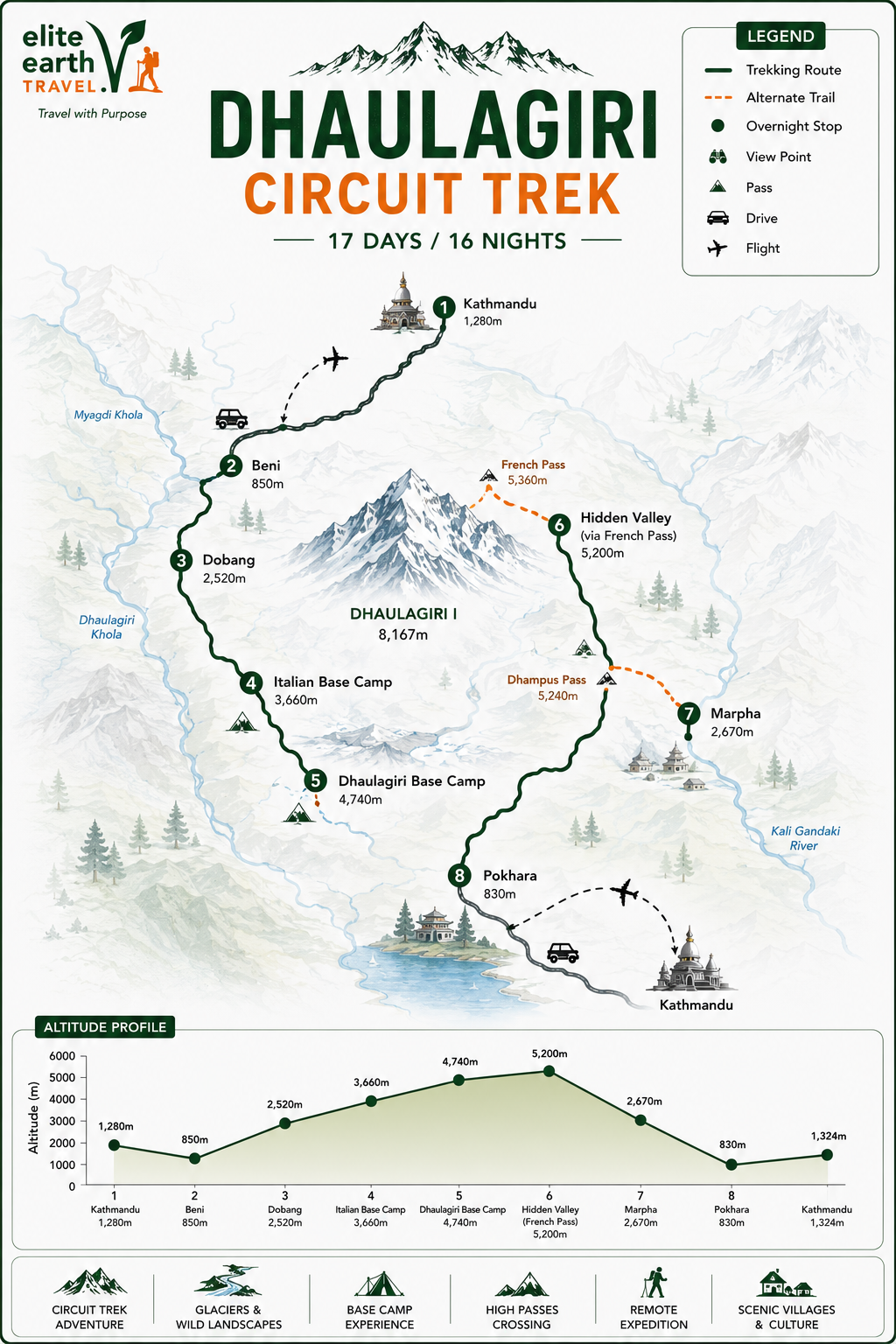
The Dhaulagiri Circuit Trek is one of Nepal's most demanding and rewarding high-altitude trekking adventures, offering an extraordinary journey around Mount Dhaulagiri (8,167 m), the seventh-highest mountain in the world. Renowned for its rugged wilderness, dramatic mountain landscapes, and remote camping experience, this spectacular trek is designed for experienced trekkers seeking an authentic Himalayan expedition far from the country's more crowded trekking routes. Combining challenging mountain passes, glacial terrain, hidden valleys, and breathtaking panoramic views, the Dhaulagiri Circuit Trek is regarded as one of the finest wilderness treks in Nepal.
Located in western Nepal, the trail circles the mighty Dhaulagiri massif through one of the most isolated regions of the Himalayas. The adventure begins with a scenic drive from Kathmandu to Beni, the traditional gateway to the Dhaulagiri region. From here, the trail follows the Myagdi Khola River, gradually ascending through charming Magar villages, terraced farmlands, dense rhododendron forests, cascading waterfalls, and narrow river gorges before entering the untouched alpine wilderness. As the trek gains altitude, lush green hills give way to rocky moraines, glaciers, snow-covered landscapes, and towering Himalayan peaks.
One of the defining features of the Dhaulagiri Circuit Trek in Nepal is its remote camping experience. Unlike many popular trekking routes, permanent teahouses are only available during the lower sections of the trail. Beyond this point, trekkers venture into pristine mountain terrain where fully supported camping becomes essential. This unique aspect allows travelers to experience the Himalayas in their purest form while enjoying unmatched solitude, breathtaking scenery, and a true sense of exploration.
The journey includes acclimatization at both Italian Base Camp (3,660 m) and Dhaulagiri Base Camp (4,750 m) before crossing two of Nepal's most spectacular high mountain passes. The ascent over French Pass (5,360 m) rewards trekkers with unforgettable views of Dhaulagiri I, Tukuche Peak, Dhampus Peak, Mukut Himal, and the surrounding glaciers. Shortly afterward, the trail enters the magnificent Hidden Valley, a vast alpine plateau surrounded by snow-capped mountains, before crossing Dhampus Pass (5,200 m) and descending into the beautiful Kali Gandaki Valley. These challenging sections represent the highlight of the expedition and provide some of the most dramatic Himalayan scenery found anywhere in Nepal.
Beyond its remarkable landscapes, the trek offers valuable cultural experiences through encounters with the indigenous Magar and Gurung communities who have lived in these mountain regions for generations. Traditional villages, ancient customs, warm hospitality, and centuries-old lifestyles provide meaningful insights into the rich cultural heritage of western Nepal while adding depth to the trekking experience.
Due to its remote location, extended duration, and high-altitude environment, the Dhaulagiri Circuit Trek is considered a challenging expedition best suited for experienced trekkers with a good level of physical fitness. Although no technical climbing skills are required, trekkers should be prepared for long walking days, glacier crossings, steep ascents, and rapidly changing mountain weather. Proper acclimatization, experienced trekking guides, and a well-planned itinerary are essential for completing the journey safely and comfortably.
The best seasons for the Dhaulagiri Circuit Trek are spring (March to May) and autumn (September to November) when stable weather, clear skies, and moderate temperatures provide ideal trekking conditions. During spring, colorful rhododendron forests bloom across the lower hillsides, while autumn offers crystal-clear mountain views and excellent visibility throughout the route.
For adventurers seeking a truly remote Himalayan experience, the Dhaulagiri Circuit Trek delivers an unforgettable combination of wilderness exploration, spectacular mountain scenery, high mountain passes, glacier trekking, and authentic cultural encounters. It is more than simply a trek around one of the world's highest peaks—it's a journey into one of Nepal's last great mountain frontiers, where every step reveals breathtaking landscapes, extraordinary challenges, and memories that will last a lifetime.
Quick Facts
| Feature | Details |
|---|---|
| Region | Dhaulagiri Region, Western Nepal |
| Duration | 17 Days |
| Maximum Altitude | 5,360 m (French Pass) |
| Trek Grade | Challenging |
| Accommodation | Hotel, Teahouse & Fully Supported Camping |
| Best Seasons | Spring (March–May) & Autumn (September–November) |
| Starting Point | Kathmandu |
| Ending Point | Kathmandu |
| Transportation | Private Vehicle |
| Permit Required | Annapurna Conservation Area Permit (ACAP) & Dhaulagiri Restricted Area Permits (if applicable based on route) |
| Major Ethnic Groups | Magar & Gurung |
| Highest Pass | French Pass (5,360 m) |
| Major Attractions | Dhaulagiri Base Camp, Italian Base Camp, Hidden Valley, French Pass, Dhampus Pass |
| Difficulty Level | Strenuous High-Altitude Camping Trek |
| Daily Walking Hours | 5–8 Hours |
Dhaulagiri Circuit Trek Difficulty
The Dhaulagiri Circuit Trek is widely regarded as one of Nepal's most challenging and adventurous trekking experiences. Unlike popular teahouse treks such as Everest Base Camp or Annapurna Base Camp, this expedition takes trekkers deep into one of the Himalayas' most remote and untouched regions, where rugged terrain, glacier crossings, and high mountain passes demand both physical endurance and mental resilience. Although no technical mountaineering skills are required, the trek is recommended for experienced trekkers who are comfortable hiking at high altitudes over multiple consecutive days.
The journey reaches its highest elevation at French Pass (5,360 m) before continuing across Hidden Valley and Dhampus Pass (5,200 m). Trekking at these elevations requires proper acclimatization, as the thinner air can increase the risk of altitude sickness. To ensure a safer and more enjoyable experience, the itinerary includes gradual altitude gain and dedicated acclimatization stops at Italian Base Camp and Dhaulagiri Base Camp, allowing trekkers sufficient time to adapt before crossing the high passes.
Trekkers should also be prepared for diverse and demanding terrain throughout the expedition. The route includes steep ascents and descents, rocky trails, glacial moraines, snow-covered sections, river crossings, and remote alpine valleys where weather conditions can change rapidly. Beyond the lower villages, accommodation shifts from teahouses to fully supported camping, adding another element of adventure to the journey.
Despite these challenges, the Dhaulagiri Circuit Trek is an incredibly rewarding experience for well-prepared trekkers. Those who complete the circuit are rewarded with spectacular views of Mount Dhaulagiri, Annapurna, Tukuche Peak, Nilgiri, Hidden Valley, and some of the most pristine mountain landscapes in Nepal.
Difficulty Overview
- Trek Grade: Challenging
- Maximum Altitude: 5,360 m (French Pass)
- Daily Walking Hours: 5–8 Hours
- Technical Climbing: Not Required
- Accommodation: Teahouse & Fully Supported Camping
- Suitable For: Experienced trekkers with good physical fitness
- Risk of Altitude Sickness: Moderate to High (Proper acclimatization required)
Best Time for Dhaulagiri Circuit Trek
The Dhaulagiri Circuit Trek can be undertaken during different seasons of the year, but spring and autumn offer the most favorable trekking conditions. These seasons provide stable weather, comfortable daytime temperatures, excellent visibility, and safer conditions for crossing the high mountain passes.
Spring (March – May)
Spring is one of the best seasons for the Dhaulagiri Circuit Trek. The lower hills and forests are covered with blooming rhododendrons, magnolias, and wildflowers, creating vibrant landscapes throughout the route. Mild temperatures, longer daylight hours, and generally stable weather make spring an excellent time for glacier crossings and high-altitude trekking. Clear skies also provide outstanding panoramic views of Dhaulagiri, Annapurna, Tukuche Peak, Nilgiri, and surrounding Himalayan ranges.
Autumn (September – November)
Autumn is considered the peak trekking season in Nepal and offers ideal conditions for the Dhaulagiri Circuit. Following the summer monsoon, the atmosphere becomes exceptionally clear, revealing uninterrupted mountain vistas and crisp alpine scenery. Dry trails, stable weather, and pleasant temperatures make this the preferred season for trekkers attempting the French Pass and Dhampus Pass.
Winter (December – February)
Winter trekking in the Dhaulagiri region offers spectacular snow-covered landscapes and fewer trekkers. However, heavy snowfall, freezing temperatures, and challenging conditions around the high passes may make the route inaccessible for extended periods. Winter is generally recommended only for experienced trekkers with appropriate equipment and support.
Monsoon (June – August)
The monsoon season transforms the lower valleys into lush green landscapes, but frequent rainfall, slippery trails, landslides, and poor visibility can make trekking difficult. River crossings become more challenging, and the high mountain scenery is often obscured by clouds. For these reasons, the monsoon season is generally not recommended for the Dhaulagiri Circuit Trek.
Dhaulagiri Circuit Trek Cost
The Dhaulagiri Circuit Trek cost varies depending on the duration of the itinerary, group size, transportation arrangements, camping logistics, guide and porter services, and the overall level of support included in the package. As this is one of Nepal's most remote camping expeditions, operational costs are generally higher than standard teahouse treks due to the need for camping equipment, kitchen staff, food supplies, and additional support personnel.
Most trekking packages include private transportation, trekking permits, hotel accommodation in Kathmandu, teahouse accommodation in lower villages, fully supported camping at higher elevations, experienced trekking guides, porters, camping crew, meals during the trek, and all necessary logistical support. Personal expenses such as travel insurance, trekking gear, snacks, beverages, charging facilities, and gratuities are typically excluded from the package price.
At Elite Earth Travel, we provide transparent and competitive pricing with no hidden charges. Our Dhaulagiri Circuit Trek packages are carefully designed to ensure safety, comfort, ethical porter welfare, and personalized service while delivering an unforgettable wilderness trekking experience in the Himalayas.
Permits Required for Dhaulagiri Circuit Trek
The Dhaulagiri Circuit Trek passes through protected mountain regions that require official trekking permits before entering the trail. Obtaining the appropriate permits helps support conservation efforts, trail maintenance, and sustainable tourism development within the Himalayan region.
Annapurna Conservation Area Permit (ACAP)
A large portion of the Dhaulagiri Circuit passes through the Annapurna Conservation Area, Nepal's largest protected conservation region. The Annapurna Conservation Area Permit (ACAP) is mandatory for all trekkers and contributes directly to environmental conservation, biodiversity protection, community development, and sustainable tourism initiatives.
Trekkers' Information Management System (TIMS) Card
Depending on the latest regulations issued by the Nepal Tourism Board and Trekking Agencies' Association of Nepal (TAAN), trekkers may also require a TIMS (Trekkers' Information Management System) Card. The TIMS system helps authorities monitor trekking activities, improve visitor safety, and facilitate emergency rescue operations when necessary.
Elite Earth Travel manages all required permit arrangements before your trek begins, allowing you to focus entirely on enjoying your Himalayan adventure while ensuring full compliance with Nepal's trekking regulations.
Accommodation and Food During the Dhaulagiri Circuit Trek
The Dhaulagiri Circuit Trek offers a unique combination of traditional teahouse accommodation and fully supported camping, making it one of Nepal's most adventurous trekking experiences. During the initial days of the trek, accommodation is provided in locally operated teahouses where trekkers can enjoy comfortable twin-sharing rooms, warm hospitality, and an authentic insight into mountain life. As the trail enters the remote alpine region beyond the permanent settlements, the journey transitions into a fully equipped camping expedition, allowing trekkers to explore some of Nepal's most isolated and untouched landscapes.
Our experienced camping crew is responsible for transporting and setting up tents, preparing fresh meals, and ensuring a safe and comfortable campsite throughout the expedition. Spacious sleeping tents, dining tents, kitchen facilities, and hygienic camping arrangements are provided to maximize comfort in the high Himalayas. Camping beneath the towering peaks of the Dhaulagiri massif creates a truly unforgettable wilderness experience that few trekking routes in Nepal can offer.
Meals during the trek are freshly prepared by our dedicated trekking cooks using locally sourced ingredients whenever possible. The menu is carefully designed to provide the energy and nutrition required for long days of high-altitude trekking while offering a variety of Nepali and international dishes.
Popular meal options include:
- Traditional Dal Bhat
- Fried Rice
- Vegetable Noodles
- Pasta
- Tibetan Bread
- Pancakes
- Porridge
- Garlic Soup
- Thukpa
- Potatoes
- Seasonal Vegetables
- Eggs
- Tea, Coffee & Hot Lemon
Elite Earth Travel also proudly offers vegan-friendly trekking meals, ensuring that travelers with plant-based dietary preferences receive balanced, nutritious, and satisfying meals throughout the expedition.
Why Choose Elite Earth Travel for Dhaulagiri Circuit Trek
At Elite Earth Travel, we believe every Himalayan journey should be safe, authentic, and memorable. Our experienced team combines extensive mountain expertise with personalized service to create trekking experiences that go beyond simply reaching the destination. From careful itinerary planning and professional logistical support to ethical tourism practices, we are committed to providing exceptional adventures while supporting local communities and protecting Nepal's natural heritage.
Our Commitment
- Highly experienced and government-licensed trekking guides.
- Professional camping crew with years of Himalayan expedition experience.
- Ethical porter welfare with fair wages, proper equipment, and comprehensive insurance.
- Carefully planned itineraries with adequate acclimatization for safer high-altitude trekking.
- Premium camping equipment for comfort and safety in remote mountain regions.
- Small group departures for a more personalized trekking experience.
- Sustainable and responsible tourism practices that directly benefit local communities.
- Vegan-friendly meal options available throughout the trek.
- 24/7 customer support before, during, and after your journey.
- Transparent pricing with no hidden charges.
Our goal is not only to guide you through the spectacular Dhaulagiri Circuit Trek, but to create a once-in-a-lifetime Himalayan adventure built on safety, professionalism, and unforgettable experiences.
✅ Airport arrival and departure transfers in Kathmandu.
✅ Private ground transportation as per the itinerary.
✅ Hotel accommodation in Kathmandu before and after the trek.
✅ Teahouse accommodation during the lower section of the trek.
✅ Fully supported camping accommodation during the remote mountain section.
✅ All camping equipment including tents, dining tent, kitchen tent, tables, and chairs.
✅ Annapurna Conservation Area Permit (ACAP).
✅ Trekkers' Information Management System (TIMS) Card (if applicable).
✅ Government-licensed English-speaking trekking guide.
✅ Professional camping crew, cooks, kitchen staff, and support team.
✅ Seasonal fruits and snacks during the expedition.
✅ Vegan meal options upon request.
✅ Guide, porter, and support staff insurance.
✅ Comprehensive first aid medical kit and pulse oximeter.
❌ International airfare.
❌ Personal travel insurance including emergency helicopter evacuation.
❌ Personal trekking clothing and equipment.
❌ Sleeping bag and personal gear rental (if required).
❌ Alcoholic beverages, bottled drinks, and soft drinks.
❌ Hot showers, battery charging, and internet services where available.
❌ Personal expenses, shopping, and souvenirs.
❌ Additional accommodation caused by flight delays, weather conditions, or unforeseen circumstances.
❌ Personal medical expenses.
❌ Personal medical expenses.
❌ Any services not specifically mentioned under "Cost Includes."
Arriving in Kathmandu for the Dhaulagiri Circuit Trek marks the beginning of a challenging and remote Himalayan adventure. The city's vibrant energy, historic temples, and lively streets provide a stark contrast to the solitude that awaits in the wild west of Nepal. As final preparations are made—gathering gear, permits, and last-minute supplies—the anticipation builds for the journey ahead: a rugged and rewarding trek around the towering Dhaulagiri massif, crossing high passes and glaciers, far from the beaten path.
The drive from Kathmandu to Beni, the gateway to Mustang and Myagdi, is an adventurous journey covering approximately 280 km. It takes around 8 to 10 hours, depending on road conditions and traffic. The route follows the Prithvi Highway, passing through scenic landscapes, including green hills, winding rivers, and terraced fields. After reaching Pokhara, the journey continues along the Baglung Highway, where the roads become narrower and more rugged, offering both thrilling and challenging moments. Along the way, we can witness rural Nepali life, small towns, and beautiful views of the Himalayas. While the road conditions can be rough in some sections, the breathtaking scenery makes the long drive worthwhile.
The trek from Beni to Babiachaur is a scenic and moderate hike that takes around 4 to 5 hours, covering approximately 15 km. The trail follows the Myagdi River, passing through lush green hills, terraced farmlands, and traditional Magar and Gurung villages. The path is mostly gentle, with some uphill and downhill sections, making it an enjoyable walk for trekkers. Along the way, we can experience the warm hospitality of the locals and observe their daily rural life. The views of distant snow-capped peaks and the sound of flowing rivers add to the beauty of the trek. Babiachaur serves as an important stop for trekkers heading toward Dhaulagiri Base Camp.
The trek from Babiachaur to Dharapani is a rewarding journey through the picturesque landscapes of Myagdi district. Covering approximately 18 km, the trek takes around 5 to 6 hours, depending on pace and trail conditions. The route follows the Myagdi River, passing through dense forests, charming villages, and terraced farmlands. Along the way, we can enjoy stunning views of the Dhaulagiri massif and surrounding hills. The trail gradually ascends with some steep sections, making it a moderately challenging hike. Dharapani, a small yet significant settlement, offers a peaceful resting spot with traditional houses and warm hospitality from the locals, making it a perfect stop before continuing toward higher altitudes.
Dharapani to Muri trek is a scenic and relatively off-the-beThe aten-path hike that offers us a chance to experience the natural beauty and cultural richness of the Annapurna region in Nepal. Starting from Dharapani, a popular stop on the Annapurna Circuit, the trail gradually ascends through lush forests, charming villages, and terraced fields, providing glimpses of traditional Gurung and Magar cultures. The route winds through remote areas, with fewer tourists compared to the main circuit, providing us a sense of tranquility and immersion in nature. As we approach Muri, the landscape opens up, offering stunning views of the surrounding peaks, including the Annapurna and Dhaulagiri ranges. Muri itself is a peaceful, less-visited village that provides an authentic experience of rural Himalayan life, with opportunities to interact with local people and learn about their customs. The trek, although challenging in parts due to its rugged terrain and steep ascents, rewards us with incredible panoramas and a deep connection to the mountains and culture of Nepal.
The trek from Muri to Boghara takes you through some of the most beautiful and remote areas of the Annapurna region, offering trekkers a chance to experience the serene beauty of rural Nepal. Departing from Muri, the trail descends through lush forests and terraced fields, passing through small villages where traditional lifestyles are still prevalent. The path is often quiet, with fewer tourists, allowing for a more intimate connection with nature and local cultures. As you make your way towards Boghara, the landscape gradually changes, with the towering peaks of the Annapurna and Dhaulagiri mountain ranges visible in the distance. The trek involves some steep ascents and descents, but the effort is well worth it as you pass through idyllic villages like Channa and its surrounding farmland, where the rural charm of the area is ever-present. Upon reaching Boghara, a peaceful village nestled in the mountains, you can enjoy the tranquility of the surroundings, with stunning views of the peaks and the opportunity to experience the warmth and hospitality of the local Gurung people. This section of the trek is a wonderful way to connect with the region’s natural beauty and culture.
The trek from Boghara to Dobang is a fascinating journey that takes us deeper into the heart of the Annapurna region, venturing through dense forests, remote villages, and picturesque landscapes. Leaving behind the peaceful village of Boghara, the trail gradually ascends, winding through subtropical forests of rhododendron and oak, with glimpses of towering mountain peaks like Annapurna and Dhaulagiri in the distance. The route takes us through small settlements, offering a chance to interact with locals and witness traditional farming practices. As you continue, the terrain becomes steeper and more rugged, and the trail narrows, requiring more effort to navigate through the dense woods. The journey to Dobang, a small, quiet settlement nestled along a river, is physically demanding but highly rewarding. Upon reaching Dobang, you can enjoy the peaceful atmosphere of the village and the surrounding forests, while relishing the views of the majestic mountains. This segment of the trek is an immersive experience in the natural beauty and cultural richness of the Annapurna region, with each step bringing you closer to the remote wilderness of Nepal’s Himalayas.
The trek from Dobang to Choriban Khola takes trekkers further into the rugged and remote terrain of the Annapurna region, offering a deeper immersion into the natural beauty and peaceful solitude of the Himalayas. From Dobang, the trail begins by ascending through dense forests of bamboo, rhododendron, and oak, with the occasional clearing that offers stunning views of the surrounding peaks. As you continue, the route becomes steeper and more challenging, with sections that require careful navigation through the rugged landscape. Along the way, we pass small streams and waterfalls, adding to the natural charm of the journey. As you approach Choriban Khola, the environment becomes even more tranquil, with the river offering a soothing backdrop to the serene surroundings. Choriban Khola itself is a remote and peaceful spot, where we can rest and enjoy the unspoiled beauty of the area. The trek is demanding, with some strenuous ascents, but it rewards adventurers with incredible views, a sense of adventure, and a chance to experience the raw, untouched wilderness of the Annapurna foothills.
The trek from Choriban Khola to Italian Base Camp is an exhilarating ascent into the high-altitude landscapes of the Annapurna region, leading us to one of the most picturesque and less-visited spots in the area. Departing from the peaceful surroundings of Choriban Khola, the trail continues through dense forests of bamboo and rhododendron, gradually climbing into more alpine terrain. As you ascend, the views become increasingly dramatic, with stunning vistas of the towering peaks of Annapurna South, Hiunchuli, and the majestic Machapuchare (Fishtail) coming into view. The path becomes more challenging as you approach higher altitudes, with some steep sections, but the landscape rewards you at every turn. Upon reaching Italian Base Camp, we are treated to breathtaking panoramic views of the Annapurna massif, a perfect spot for resting and soaking in the beauty of the surrounding mountains. The camp, named after the Italian expedition team that explored the area in the 1950s, offers a serene and isolated setting, providing us with a unique experience of the high Himalayas. The trek is both physically demanding and rewarding, taking you into the heart of the Annapurna Sanctuary with stunning views, quiet surroundings, and a profound sense of connection to the mountains.
The trek from Italian Base Camp to Glacier Camp is a short but exhilarating climb that takes us closer to the heart of the Annapurna Sanctuary. From Italian Base Camp, the trail ascends steeply, passing through rocky terrain and alpine meadows, with increasingly spectacular views of Annapurna South, Machapuchare (Fishtail), and other surrounding peaks. As you approach Glacier Camp, the landscape becomes more rugged, with glaciers and snow-capped peaks coming into sharper focus. Glacier Camp itself is situated at a higher altitude, offering us an incredible vantage point to experience the raw beauty of the Himalayas. The trek is physically demanding due to the altitude and steep terrain, but the reward is well worth the effort, with panoramic views and the serene atmosphere of the high mountains.
The trek from Glacier Camp to Dhaulagiri Base Camp is a challenging and exhilarating journey that takes us into the rugged, remote wilderness of the Dhaulagiri massif. Leaving Glacier Camp, the trail becomes progressively more demanding as it ascends steep, rocky paths and traverses glaciers and moraines. The terrain is often exposed, requiring careful navigation, especially at higher altitudes. As you approach Dhaulagiri Base Camp, the towering presence of Dhaulagiri I (8,167 meters) becomes increasingly dominant, offering a breathtaking view of one of the world’s highest peaks. The base camp itself provides an awe-inspiring and peaceful atmosphere, surrounded by dramatic snow-capped mountains and glaciers. This trek is a physically demanding, high-altitude adventure, but it rewards us with some of the most stunning and unspoiled views in the Himalayas.
Acclimatization at Dhaulagiri Base Camp is an essential part of the climbing process, as it allows us to adapt to the high altitude before making further ascents. Located at around 4,750 meters (15,580 feet), the base camp is where climbers and trekkers spend several days resting and gradually adjusting to the thin air.
The trek from Dhaulagiri Base Camp to Hidden Valley via French Pass is a breathtaking and high-altitude adventure that offers stunning panoramic views of the surrounding Himalayan peaks. From Dhaulagiri Base Camp, the trail ascends steeply towards French Pass (5,360 meters), a high, rocky col that provides sweeping views of Dhaulagiri, Tukuche Peak, and the surrounding glaciers. The pass itself is challenging, with rocky terrain and potential snow or ice, but it is an unforgettable experience. After crossing French Pass, the route descends into the remote and serene Hidden Valley, a stunning alpine area surrounded by snow-capped peaks. Hidden Valley is a peaceful, isolated spot, offering trekkers a chance to rest and take in the pristine beauty of the landscape. This trek is physically demanding due to the altitude and rugged terrain, but it rewards us with some of the most spectacular views and a true sense of adventure in the heart of the Himalayas.
The trek from Hidden Valley to Yak Kharka via Dhampus Pass is a rewarding and scenic journey that takes us through a variety of landscapes, from alpine meadows to rugged ridges. Leaving the peaceful Hidden Valley, the trail ascends towards Dhampus Pass (5,244 meters), offering spectacular views of the Dhaulagiri and Annapurna ranges. The pass itself provides a challenging climb, with rocky terrain and steep sections, but the panoramic vistas of snow-capped peaks make it well worth the effort. After crossing the pass, the trail descends gradually through alpine pastures and forests, eventually reaching Yak Kharka, a small settlement known for its tranquil atmosphere and stunning mountain views. The trek is physically demanding, but the combination of high-altitude vistas and the serene beauty of Yak Kharka makes it a memorable part of the journey through the Annapurna and Dhaulagiri regions.
The trek from Yak Kharka to Marpha takes trekkers through a stunning transition from high-altitude landscapes to the lower, more temperate areas of the Annapurna region. Leaving Yak Kharka, the trail descends gradually, passing through rocky terrain, sparse alpine meadows, and beautiful forests. As the trek progresses, the landscape transforms into a more arid, Tibetan-influenced environment, with views of the majestic Annapurna and Dhaulagiri ranges. The route leads you through the village of Khingar before reaching Marpha, a charming and picturesque village famous for its whitewashed stone houses and apple orchards. Marpha, located along the Kali Gandaki River, offers a peaceful, scenic atmosphere and serves as a cultural hub in the region, making it a perfect place to relax and enjoy the traditional hospitality of the local Thakali people. The trek is moderate in difficulty, with a gradual descent that provides rewarding views and a chance to experience the unique cultural blend of the region.
The drive from Marpha to Pokhara is a scenic journey that takes you from the tranquil, mountainous village of Marpha to the vibrant lakeside city of Pokhara. The route follows the Kali Gandaki River, passing through terraced fields, deep valleys, and small villages, with stunning views of the surrounding Annapurna and Dhaulagiri mountain ranges. As you descend from the higher altitudes, the landscape gradually transforms from arid, Tibetan-style terrain to more lush, green hills. The road, though winding and sometimes rough, offers a chance to witness the rural life of Nepal, with occasional stops to enjoy the local culture. The drive is approximately 4 to 6 hours, depending on road conditions, and ends in Pokhara, where trekkers can relax by the serene Phewa Lake or explore the lively city. The contrast between the remote village of Marpha and the bustling, scenic atmosphere of Pokhara makes the drive an enjoyable and memorable part of the journey.
The drive from Pokhara to Kathmandu typically takes around 6 to 8 hours, covering a distance of about 200 kilometers. The journey takes you through winding roads, with scenic views of the mountains, rivers, and rural villages along the way. The route follows the Prithvi Highway, passing through towns like Dumre and Muglin, where you can experience the vibrant local culture. While the drive can be bumpy at times due to road conditions, it offers stunning landscapes, including glimpses of the Himalayan range, making it a memorable experience.